The One Page Operating System Helping Us Raise Our Daughters With Intention
Most parents have hopes for who their children will become. But have we defined who we need to be while raising them? Parenting is probably the most important work we will ever do, and somehow, nobody gives us a guidebook for doing it well.
We bring our children home and begin making thousands of decisions on their behalf. Where will they go to school? How will we discipline them? What activities will we encourage? How much should we protect them from, and when should we let them struggle? How will we talk about money, faith, friendship, failure, bodies, technology, love, and the complicated world they are inheriting?
Of course, we want our children to be happy. We want them to be healthy, kind, capable, and successful. But what does any of that actually mean?
And perhaps more importantly, how do we make sure the small choices we make every day are leading us toward the future we say we want for them?
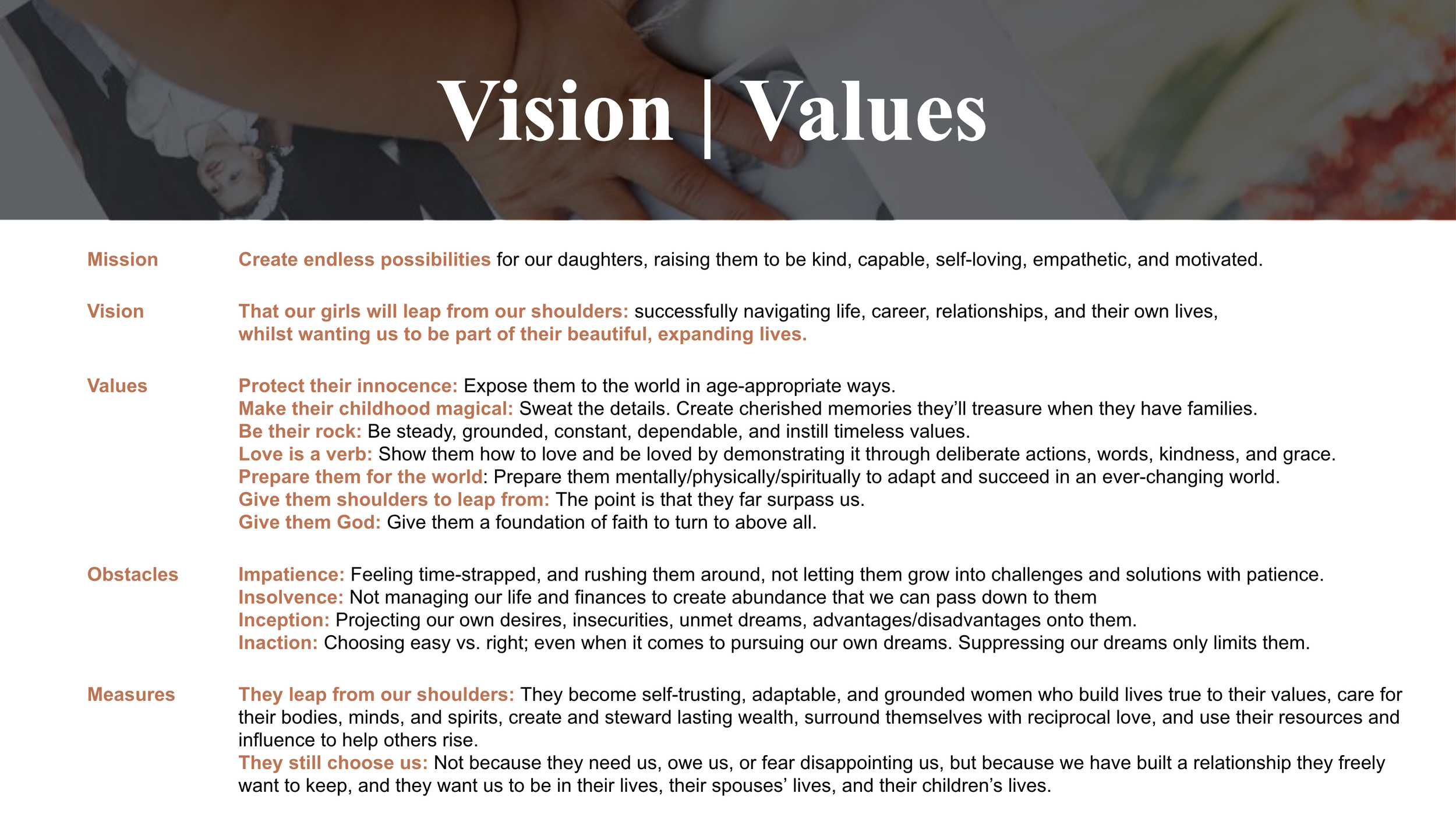
Those questions are what led Ronnie and me to create a Vision to Values framework for our family. It fits on a single page, but it has given us something every family needs: a shared definition of what we are building, a practical operating system for how we want to build it, and a way to recognize the habits that could quietly pull us off course.
The Framework That Changed How I Think About Decision-Making
I first learned about the Vision to Values framework while building Archie with Jaclyn.
I have encountered plenty of frameworks throughout my career. Many companies have mission statements. Most leadership teams have goals. Some have elaborate operating systems filled with principles, processes, scorecards, and quarterly priorities.
What struck me about this framework was how much it accomplished without becoming heavy.
It established a mission. It defined the outcome we were trying to create. Then it gave us an operating system through which we could evaluate the decisions required to get there. At Archie, it created a shared language that Jaclyn and I could use as we built together. We could ask one another questions like, “Are we bringing the magic?” or “Would we put this on the nanny cam?”
Those phrases may sound simple, but that is precisely why they worked. We did not need to reopen a lengthy strategy document every time we faced a decision. We had memorable standards that helped us recognize what belonged and what did not.
If we would not be proud for a mother to see how a decision had been made, we did not make it that way. If an experience was functional but lacked the care and delight we wanted Archie to represent, we knew it was not finished yet.
The framework gave us a shared lens. That lens improved the consistency and quality of our decisions, while also making many of those decisions easier.
Eventually, I began wondering: If this could be so powerful for two founders building a company together, what could it do for two parents building a family together?
A Mission Is Meaningful. An Operating System Makes It Useful.
Many of us have a loose mission for our families, even if we have never written it down: We want to raise good humans. We want our children to feel loved. We want to give them opportunities. We want them to become successful adults.
Those hopes matter, but they are not always specific enough to guide us through real life. They may not tell us whether a particular school is right for our child. They may not tell us when to step in and when to let her struggle. They may not help us recognize when our impatience is teaching something we do not want her to learn.
A family operating system turns our aspirations into something we can actually use… It gives us bumpers down the bowling lane. We will not throw every ball perfectly, but we have a better chance of moving in the direction we intended.
Our Vision to Values framework includes five parts:
Mission: What are we here to do?
Vision: What future are we trying to create?
Values: How do we behave as we build that future?
Obstacles: What tendencies could pull us away from it?
Measures: How will we know whether we succeeded?
Each section answers a different question, but together they create one cohesive system for making decisions and holding ourselves accountable.
Our Family Mission
Our mission is: Create endless possibilities for our daughters, raising them to be kind, capable, self-loving, empathetic, and motivated.
This is our most concise expression of what we believe our role is. It is not to prescribe the exact lives our daughters should build. It is not to ensure that nothing difficult ever happens to them. It is not even to hand them a perfectly paved road. Our job is to create possibilities and prepare them to navigate those possibilities well. That distinction matters. We do not want to build their lives for them. We want to help them develop the self-trust, character, skills, resources, and courage to build lives that are truly theirs.
Our Vision
Our vision is: That our girls will leap from our shoulders, successfully navigating life, career, relationships, and their own lives, whilst wanting us to be part of their beautiful, expanding lives.
I love the image of our daughters leaping from our shoulders. The point is not for them to replicate our lives or stop at the places we were able to reach. The point is for them to begin with the love, wisdom, access, security, and opportunity we can give them, and then go farther. We want them to surpass us. But there is another part of our vision that matters just as much: we want them to choose us.
One day, our daughters will no longer need us to run their schedules, solve their problems, or provide their homes. Success, to me, would be raising women capable of building full lives without us, while creating the kind of relationship that makes them genuinely want us in those lives. Not because they owe us. Not because they fear disappointing us. Not because we have made them responsible for our happiness. Because they enjoy us. Because they trust us. Because they know we respect who they have become. Because they want us at their kitchen tables, in their spouses’ lives, and, if they choose to have children, in our grandchildren’s lives too.
Our Family Values
Values are where the framework begins to enter everyday life. They give us a set of standards against which we can check our actions.
Protect their innocence. We want to expose our daughters to the world in age-appropriate ways. Preparing children for reality does not require giving them every reality before they are ready to hold it. We want to preserve the softness, wonder, safety, and freedom of childhood while gradually equipping them for what lies beyond it.
Make their childhood magical. We want to sweat the details and create cherished memories they may carry into homes and families of their own one day. This does not mean every day needs to be elaborate or picture-perfect. Magic can be pancakes shaped like hearts, music playing while we cook dinner, a note tucked into a lunchbox, or a tradition repeated so faithfully that it becomes part of the architecture of their childhood. It means caring about how life feels while we are living it.
Be their rock. We want to be steady, grounded, constant, and dependable while instilling timeless values. Our daughters will encounter enough uncertainty in the world. Home should be the place where they know what love feels like, where they know what we stand for, and where they trust that we will continue showing up.
Love is a verb. We want to teach our daughters how to love and be loved by demonstrating it through deliberate actions, words, kindness, and grace. Love is not simply something we feel. It is something we practice. The way Ronnie and I speak to each other matters. The way we apologize matters. The way we care for our family, our friends, our community, and ourselves matters. Our daughters will learn what love looks like partly by watching what we are willing to do in its name.
Prepare them for the world. We want to prepare them mentally, physically, and spiritually to adapt and succeed in an ever-changing world. The future our daughters will inherit will look different from the world in which we grew up. Technology will change. Careers will change. The environment, economy, and skills required to thrive will continue changing too. We cannot predict every challenge they will face, but we can help them become people who know how to learn, adapt, care for themselves, solve problems, recover from setbacks, and begin again.
Give them shoulders to leap from. The point is for them to far surpass us. We want to give them the advantage of what we have learned, built, earned, and healed. We want them to inherit resources, certainly, but also confidence, knowledge, relationships, emotional skills, financial literacy, and a belief in what is possible. They should not have to start where we started.
Give them God. We want to give them a foundation of faith to turn to above all. There will be questions we cannot answer, burdens we cannot carry for them, and seasons when we cannot offer the comfort they need. We want them to know that there is something larger than themselves, and larger than us, in which they can place their faith.
The Most Honest Part of the Framework: Our Obstacles
The obstacles may be my favorite part of this entire exercise because this is where the framework becomes honest.
Most of us know the kind of parents we want to be. The harder work is identifying the tendencies within us that might keep us from becoming those people. Obstacles help us name the gap between our intentions and our actions. Ours are:
Impatience. When we feel time-strapped, we can rush our children rather than giving them the space to grow into challenges and discover solutions. It is often faster to put on the shoes, fix the toy, answer the question, or complete the task ourselves. But efficiency is not always the goal. Sometimes our desire to move quickly interrupts the exact learning we say we want to create.
Insolvency. If we do not manage our lives and finances wisely, we may be unable to create the abundance, stability, and opportunity we hope to pass down. This is not simply about accumulating money. It is about stewarding our health, energy, time, careers, relationships, and financial resources so that we have something meaningful to give.
Inception. We may project our own desires, insecurities, unmet dreams, advantages, or disadvantages onto our daughters. They are not blank canvases on which we get to paint the lives we wish we had lived. They are their own people. Our job is to help them discover who they are, not quietly reward them for becoming who we imagined.
Inaction. We may choose what is easy over what is right, including when it comes to pursuing our own dreams. Our children learn from what we model. If we continually abandon our own gifts, tolerate lives that make us miserable, or allow fear to dictate our choices, they may absorb those behaviors more deeply than any lesson we try to teach them. Suppressing our dreams does not necessarily serve our children. Sometimes it quietly teaches them to suppress theirs too.
Naming these obstacles does not mean we will never fall into them. Of course we will. The purpose is not perfection. The purpose is recognition.
When I find myself behaving in a way I would not want my daughters to repeat, I now have a barometer. I can notice what is happening, name it, and choose again.
How We Will Measure Success
The final section begins with the end in mind. We have two measures for success:
They leap from our shoulders. They become self-trusting, adaptable, and grounded women who build lives true to their values; care for their bodies, minds, and spirits; create and steward lasting wealth; surround themselves with reciprocal love; and use their resources and influence to help others rise.
They still choose us. Not because they need us, owe us, or fear disappointing us, but because we have built a relationship they freely want to keep. They want us to be part of their lives, their spouses’ lives, and their children’s lives.
There are countless outcomes in our daughters’ lives that we will not be able to control. We cannot choose their professions, partners, beliefs, interests, or definitions of a meaningful life. Nor should we.
Our measures are less about the specific lives they build and more about the capacity and freedom with which they build them: Do they know themselves? Can they trust themselves? Can they care for themselves? Can they adapt when life changes? Can they build reciprocal relationships? Can they create and steward resources? Can they use their power well And after all of that, do they know that our relationship is a place they can return to freely, not a debt they are obligated to repay?
That is our definition of success.
How to Create a Vision to Values Framework for Your Family
One partner may naturally be more inclined to initiate an exercise like this. That was true in our house.
Because I had already used the framework while building Archie, I took the first pass. Then I brought it to Ronnie and invited him into the process. I asked him to sit with it, challenge it, and consider what was missing.
You do not have to begin with a blank page together. One person can create something for the other to react to. The important part is that the final framework reflects the family you both want to build.
Begin with these five questions:
What is our mission as parents? Complete the sentence:
“We are here to…”
Keep it concise. What do you believe your fundamental responsibility is to your children?What future are we trying to create? Write down a few ideas prompted by the following questions:
Imagine your children as adults… Who have they become? How do they move through the world? What do they believe about themselves? What kinds of lives and relationships have they built? What role do you hope to have in their lives?What values must guide us? Journal using the following questions as reflection prompts:
How do we want our home to feel? What do we want our children to learn from watching us? What standards should shape our everyday decisions? What do we want to protect, practice, and prioritize?
Choose language your family will actually remember and use.“Make their childhood magical” is more useful to me than a single abstract word like “joy” because it immediately prompts me to think about my actions.What could pull us off course?
This is where you have to be honest. Consider your recurring tendencies, fears, pressures, and blind spots. What do you do when you are stressed? What are you tempted to prioritize at the expense of what matters? What patterns from your own childhood do you want to interrupt? What unresolved desires might you accidentally place on your children?
The goal is not to shame yourself. It is to recognize yourself.How will we know if we succeeded?
Try to look beyond accomplishments. Your child may earn impressive degrees, build wealth, win awards, or have a beautiful family, but those achievements alone may not tell you whether she trusts herself, feels whole, experiences reciprocal love, or is living a life she truly chose.
Define success according to the human being you hope to help raise, not simply the resume you hope she creates.
A Living Framework, Not a Perfect One
Our daughters are still very young. At this stage of our family’s life, protecting their innocence and bringing the magic carry enormous weight. As they grow and reveal more of who they are, I imagine parts of this framework will evolve.
That is not a flaw. It is part of the point.
This is not a constitution carved in stone. It is a living touchstone for the family we are becoming. We can revisit it, revise it, and allow it to mature alongside our daughters.
Its value is not that it gives us every answer. Its value is that it gives us a shared place from which to begin.
When we are evaluating a school, an activity, a family rhythm, or a difficult conversation, we can return to it. When life becomes busy and we realize we have been rushing everyone through the day, we can return to it. When we are deciding how much truth our daughters are ready to hold, we can ask whether we are protecting their innocence while preparing them for the world. When I wonder whether I am living what I hope to teach, I can return to it too:
Did I model capability today?
Was I the rock they needed?
Did I practice love in a way they could see and feel?
Did I make room for magic?
Did I give them God?
No one-page framework can make us perfect parents. That is not what our children need anyway… But it can keep us awake to the work.
It can lighten our mental load by making our priorities clearer. It can create a common language between partners. It can make complicated decisions easier by giving us a consistent lens through which to view them.
And perhaps most importantly, it can help us remember that parenting is not simply about managing the childhood directly in front of us: We are raising people who will one day leave our homes, build lives of their own, and decide what parts of their childhood they want to carry forward.
Our hope is that our girls will leap from our shoulders into lives more expansive than we can currently imagine. And when they do, we hope they will still reach back for our hands.