How to make enough food, time it all right, and actually enjoy the people around your table
I spent every Sunday of my childhood eating dinner with the same three families. We called ourselves "the Commune," when I tell people this they always say “You grew up in a what?!” No, I did not grow up in a commune, it’s just what we called ourselves. And still do.
Our moms were best friends. They called themselves the Yayas, and they are literally the most incredible women ever, to this day. Every Sunday, our families gathered, the host house always rotating, and fed us fabulously.
One mom brought the appetizers. One made dinner and a side. One brought dessert. That was the system. It was incredibly simple, and it was literally perfect.
As a child, I thought Sunday dinner simply appeared. As an adult, I can finally see the thought, effort, and love behind the magic the Yaya’s created. The work was shared. The roles were clear. No one person carried the entire meal, and no one arrived with a surprise casserole that needed the exact oven temperature already being used by the chicken.
We ate some of the best meals of my entire childhood on Sundays with the Commune. But the thing I remember most is not any one dish. I remember the rhythm of it. The same people, returning to the same table, week after week. The adults talking. The kids playing. Everyone staying a little longer than they probably planned.
The food was incredible, but the tradition was the real feast. I didn’t realize it at the time, but the Yayas taught me that cooking is one of the greatest ways we can love our people. There is something incredibly intimate about thinking of the people you love, considering what might nourish or delight them, and then using your own two hands to make it appear. A pot of something warm on the stove. A bottle of wine opened on the counter. A table set with enough seats for everyone.
Cooking says: I thought about you before you arrived. I am so glad you are here. Sit down. Let me take care of you for a while. And yet, so many people shy away from inviting others over for dinner because the act of hosting can be STRESSFUL.
How much food do you make? How do you ensure everyone gets enough without spending twice what you need to spend? What should you prepare in advance? What still needs to be cooking when your guests arrive? How in the world do you get the chicken, the vegetables, and the potatoes onto the table at the same time, while everything is still hot And perhaps the most important question: How do you cook for the people you love without spending the entire evening away from them, alone in the kitchen?
Because if the purpose of the meal is to gather with your people, being trapped at the stove while everyone else is laughing in the next room kind of defeats the point.
This is why I love Ina Garten. Ina has made a career out of showing us that a meal can feel special without being complicated, and that the best host is not necessarily the one who made the most dishes. She is the one who created the conditions for everyone, including herself, to relax and enjoy the night.
So, inspired by Ina and tested against a childhood full of the best Sunday dinners, here is my best advice for feeding your people….
Rule No. 1: You Do Not Have to Make Everything
When people ask, "What can I bring?" LET THEM BRING SOMETHING. This is not failing to host. It is letting people participate. If you are hosting, I think it makes sense to own the main course and the sides. Those are the dishes most likely to require reheating, oven space, or last-minute attention, so it is helpful for them to live in the kitchen where dinner will be served. But appetizers and desserts? Hand them off, guilt-free.
The Commune model worked because everyone contributed, but no one competed. One person owned the beginning of the meal. One person owned the center. One person owned the sweet ending. And if you ask me, that is a pretty great metaphor for friendship: You do not need to be everything to everyone. You simply need to bring what is yours to bring.
So when someone offers to help, give her a real assignment: "Could you bring a simple appetizer for eight that can be served at room temperature?" "Would you bring dessert? Anything you love would be wonderful." Clear is kind. Specific is helpful. Shared effort makes it possible for everyone to enjoy the evening.
Rule No. 2: Use Ina's Formula for How Much to Make
One of the most anxiety-producing parts of feeding a group is figuring out how much food "enough" actually is. You do not want anyone leaving hungry, obviously. But buying and preparing twice what you need is expensive, exhausting, and wasteful.
Ina's rule, developed during her catering years, makes it easy:
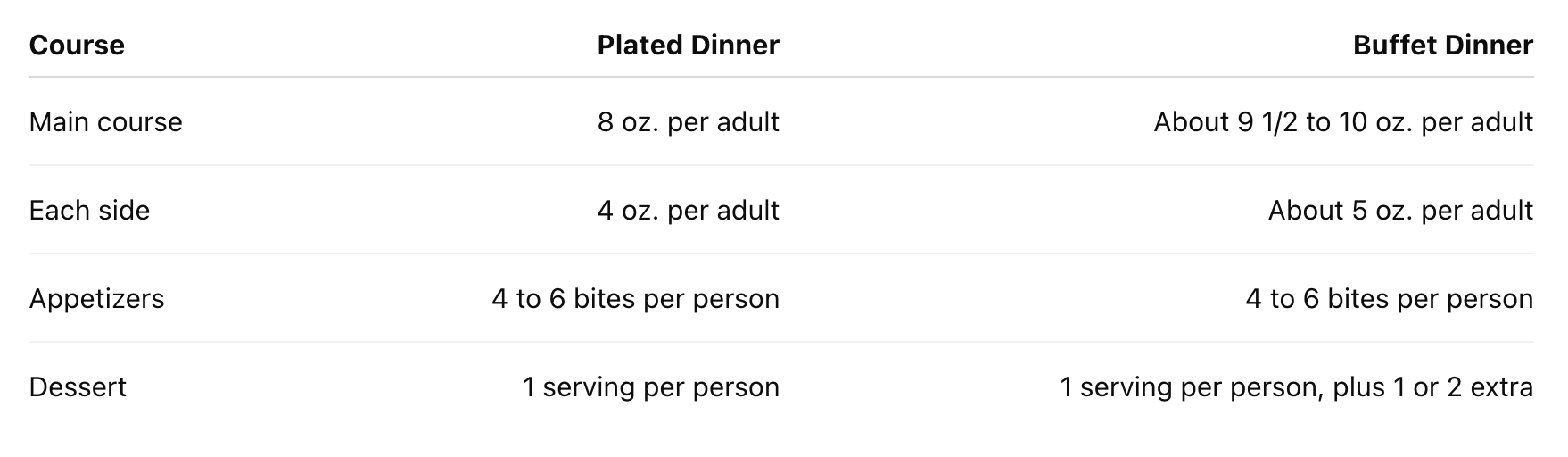
Plan for 1/2 pound, or 8 ounces, of the main course per adult.
Plan for 1/4 pound, or 4 ounces, of each side per adult.
For eight adults, that means approximately four pounds of the main course and two pounds of each side.
Ina admits she often makes a little extra, and SAME. But a little extra is different from doubling the entire meal because you are terrified someone might want a third chicken breast.
She also suggests that if you are serving the meal buffet-style, to increase the main course and sides by about ~20%. People naturally take slightly larger portions when they serve themselves, and a buffet makes seconds part of the experience.
For appetizers, plan for roughly four to six bites per person when a full dinner follows. You are giving people something to enjoy with a drink, not secretly serving them an entire first dinner.
For dessert, plan for one serving per person, then add one or two extra servings if you want a cushion.
Children generally eat less. Bone-in meat may require more weight. A meal with four sides will require smaller quantities of each than a meal with one. But this gives you what anxiety never will: a useful place to begin.
Here’s a cheat code for you to screenshot.
Rule No. 3: Cast the Plate Like a Play
Ina says she chooses the courses in a meal the way a director casts a play. There should be one star on the plate, and everything else should play a supporting role.
I LOVE this.
Our instinct, especially when we are excited to cook for people, is often to make everything special. A boldly seasoned chicken! Truffled potatoes! Spicy Brussels sprouts! A salad with twelve ingredients! Suddenly every dish is delivering a monologue at the same time.
As Ina puts it, you do not want all the flavors screaming at you at once. Choose the star first. It might be the main course, but it does not have to be. Ina sometimes builds the entire plate around her truffled mashed potatoes, then pairs them with simply prepared chicken and broccolini. Once you know the star, let the other dishes make it shine:
If the main course is rich, keep the vegetable bright and simple.
If the side is creamy and indulgent, choose a clean, straightforward protein.
If one dish has a powerful sauce or spice profile, let the others be quieter.
One memorable dish is hospitality. Four complicated dishes are a hostage situation. Your guests do not need every bite to be the best bite of their lives. Give them one thing to rave about, then allow the rest of the plate to do what a good supporting cast does: make the star look even better.
Rule No. 4: Build the Menu Around Your Attention
The first question we usually ask when planning dinner is, "What sounds good?"
The more important question Ina has taught me to ask is, "What will all of these recipes require from me at 6:30?" Because four individually easy recipes can create one spectacularly difficult hour if they all need your attention at the same time. Ina's wonderfully practical formula is this:
Make one thing on top of the stove.
Make one thing in the oven.
Make one thing that can be served at room temperature or prepared ahead.
That is the game plan.
You are not eliminating cooking, but you are eliminating competition for your hands, burners, oven racks, and brain.
This is such an important distinction. Hosting becomes overwhelming not necessarily because there is too much to do, but because too many things need to be done by the same person at the same time.
Rule No. 5: Decide What Actually Needs to Be Hot
Not every dish deserves the pressure of being served at the exact moment it finishes cooking. Before you finalize the menu, sort each dish into one of four categories:
Made ahead: braises, soups, sauces, casseroles, dressings, chilled desserts
Served at room temperature: appetizers, cheese boards, bread, salads, (some) roasted vegetables
Reheated: a prepared main course or side dish
Finished live: stovetop dish and/or an oven dish
This is the difference between having a menu and having a plan. Ina is masterful at combining dishes with different timelines. She is still serving a great meal. She just moved the labor away from the moment her guests are standing in her kitchen. Brilliant!
Once you know what must happen live, work backward from the time you want to eat. If dinner is at 6:30, write down when the oven dish goes in, when the main course begins reheating, and when the salad gets dressed. Then add ten or fifteen minutes of breathing room.
Someone will be late. A child will need something. You will realize you forgot to put water on the table. Life will continue to be life, even when company is coming. Build enough room into the plan to enjoy it.
Rule No. 6: Keep the Appetizers Effortless
Appetizers should buy the host time. They should not create another deadline.
My favorite way to do Apps is to not do them. Ask a guest to bring them (just like the Yayas did!), and if you’re asking, do it right, give her some direction: "Something simple for eight that can be served at room temperature" is much more helpful than "Bring whatever!"
If you insist on the pressure of doing your own apps: Choose something that can be set out before the first guest arrives and eaten easily while holding a drink. Ina recommends: good cheese, crackers, nuts, olives, and a ymmmy spread, like a fig marmalade.
Rule No. 7: Cook in the Things You That Make Cleaning Easier
I love cooking and serving in things that can go straight into the dishwasher.
I know plenty of people do not love putting their pots and pans in there. I am not one of those people. If a Dutch oven or baking dish can move from cooking, to serving, to cleanup without creating three more things to wash, it is invited to dinner. My Pyrex baking dishes are workhorses for exactly this reason. The larger point is this: consider cleanup when you choose both the recipe and the dish you will make it in.
A dinner party does not become more meaningful because you have seven hand-wash-only pans waiting beside the sink.
Rule No. 8: Let Cleanup Be Communal Too
When dinner is finished, I ask guests to bring their plates to the sink, scrape any remaining food into the trash, and give their plates and utensils a quick rinse. Is it sexy? No. Does it take SO MUCH pressure off me? Yes!
It means the table can settle into sobremesa, that wonderful stretch of conversation after a meal, without the host staring at a mountain of crusted plates and feeling responsible for making it disappear immediately.
Shared cleanup does not end the evening. It protects it. With the most annoying part handled, everyone can pour another glass, return to the table, and stay awhile.
Rule No. 9: Remember What Dinner Is For in the First Place
Your people are not coming to your house to evaluate whether the chicken and green beans reached the table within the same sixty seconds. They are coming to be with you.
The food matters because it creates the conditions for everything else. The stories. The laughter. The second helping. The kiddo falling asleep on someone's lap. The conversation that continues far longer than anyone planned.
What I remember about Sundays with the Commune is that we ate incredibly well. But what those dinners gave me was so much bigger than dinner: They gave me a childhood filled with adults who loved one another, families who kept showing up, and a table I knew would be full every Sunday night.
Because our moms shared the cooking, they created a tradition that was realistic and lived-in. They showed us that loving your people does not always require a grand gesture. Sometimes it looks like bringing the appetizer. Sometimes it looks like roasting the chicken. Sometimes it looks like slicing the pie. Sometimes its looks like pulling up your seat and enjoying a meal that was made by someone who loves you.
So invite the people. Let them bring something. Make enough, but not twice enough. Choose one star for the plate. Build a menu that does not need every burner and every ounce of your attention. Put the plates by the sink when dinner is over. Then sit back down.
Because cooking may be one of the greatest ways to love your people, but being present with them is the real goal.